AI Agent: Conversational Orchestrator
A two-part system that powers all of my AI experiences: a Go service that sits in front of the HomeStack AI gateway and stores every agent/session/message in MySQL, plus a Next.js operator console for managing agents and reviewing conversations.
Overview
mono/ai-agent-api is the control plane for my AI-powered experiences. It defines agent behavior (prompt, model, tool schema, fallback order), tracks long-running conversations, persists every message/tool call, and proxies completions through ai-api with centralized authentication and cost controls. Products such as Code Editor, Chat-GPT, and AI-Agent-Admin talk to this service instead of hitting providers directly.
mono/ai-agent-admin is the control room that sits on top of it: a secure UI for creating/editing agents, auditing tool calls, filtering conversations, and inspecting session state without touching the database.
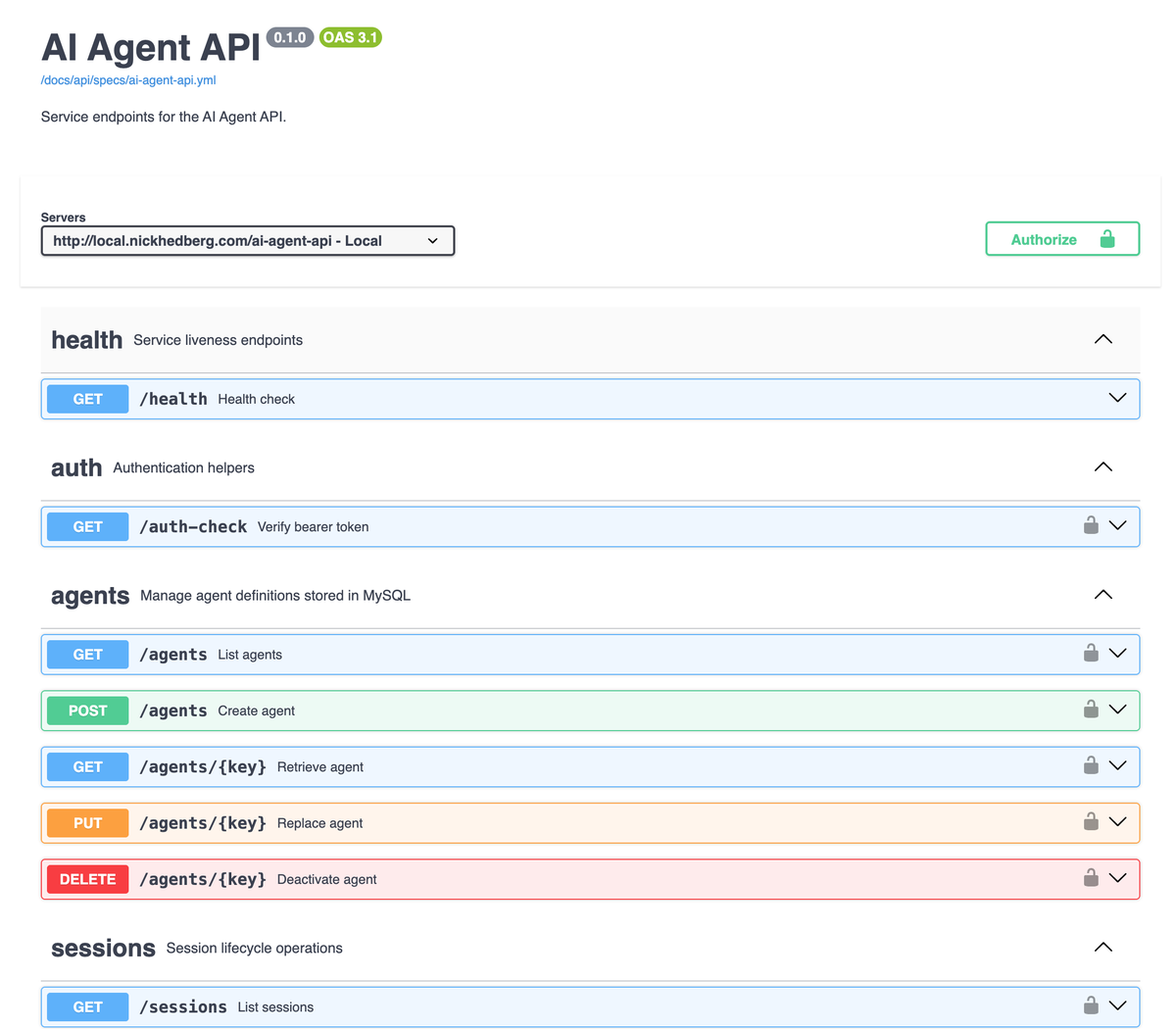
AI-Agent-API
Agent Governance
- Structured Catalog: Agents live in the
agenttable with key, display name, system prompt, default/fallback models, temperature, metadata, and JSON tool definitions. - CRUD API:
/ai-agent-api/agentssupports pagination, creation, updates, and soft deletes with cursor-based navigation and validation. - Unsupported Flags: Each response includes an
unsupported_modelsarray so downstream UIs can highlight fallback combos that no longer exist upstream.
Session & Conversation Graph
- Dual Containers: Conversations group multiple sessions over time, while sessions represent a single run tied to one agent and override settings such as allowed tools or temperature.
- Message Audit Trail: Every message stores role, model, tool call payload, metadata, and timestamps, making it easy to replay or export transcripts.
- Tool Awareness: The store persists tool_call ids and function arguments so tool responses can be reconciled even after retries.
Upstream Proxy & Streaming
- Unified Client: The handler translates stored history into OpenAI-style
chat.completionspayloads and forwards them toai-api, which then routes to OpenAI, Anthropic, Gemini, etc. - Streaming Support: If the request advertises
text/event-stream, the service upgrades the connection, streams deltas back to the caller, and saves assistant/tool messages when the stream finishes. - Idempotent Writes: An LRU cache deduplicates
POST /sessions/{id}/messageswhen clients send anIdempotency-Key, preventing double replies on network retries.
Technical Architecture
mono/ai-agent-api/
├── handlers/        # HTTP handlers for agents, sessions, conversations, models
├── internal/
│   ├── agents/      # Repository (MySQL) + domain models
│   ├── sessions/    # Conversation store, pagination, tool call structs
│   ├── litellm/     # HTTP client wrapper
│   ├── models/      # Catalog client for supported models
│   └── idempotency/ # TTL cache
└── main.go          # Router wiring + dependency injection
The service uses Go 1.22 with the new http.ServeMux pattern, so routes look like:
mux.Handle("POST /ai-agent-api/sessions/{id}/messages",
  handlers.RequireBearer(masterKey, addMessageHandler))
Each handler executes three layers:
- Auth:
handlers.RequireBearerenforces the master key and short-circuits unauthorized calls. - Store Interaction: Reads/writes against MySQL via repositories (
agents.SQLRepository,sessions.Store). - Upstream AI Calls: Builds
openai.ChatCompletionNewParams, forwards them to the configured AI gateway, and persists resulting assistant/tool messages.
AI-Agent-Admin
A Next.js 15 application that authenticates through Auth0, enforces role-based access, and proxies every request through the same host so the UI never exposes raw API keys.
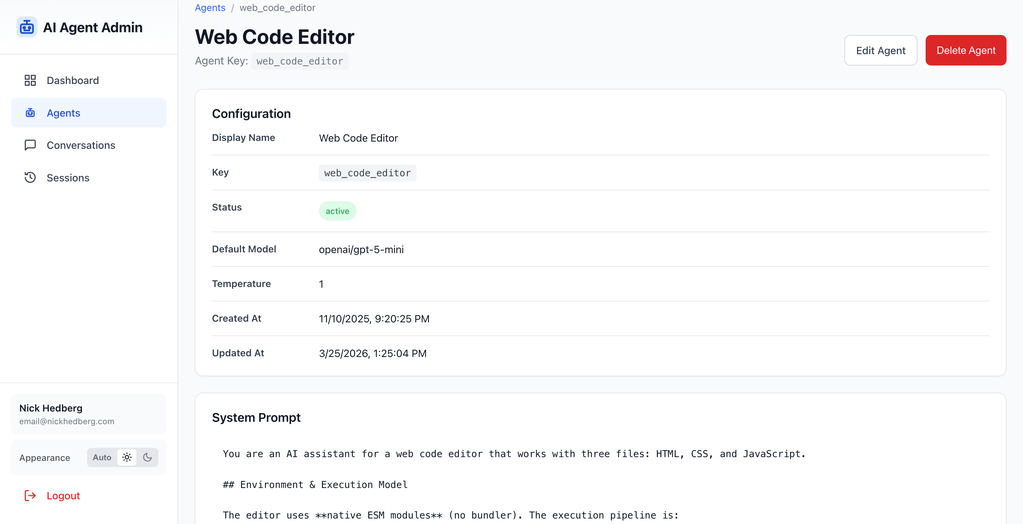
Agent Management
- List View:
/agentsfetchesGET /ai-agent-api/agents, displays status badges, fallback warnings, and updated timestamps withClientDate. - Detail & Edit: Dynamic routes (
/agents/[key]) surface prompt text, tool definitions, unsupported model warnings, and offer edit/delete actions. - Proxy Mutations: All CRUD actions flow through
/ai-agent-admin/api/ai-agent/..., which injects the master key and streams the upstream response straight back to the browser.
Conversations & Sessions
- Conversation Search: Server-side data fetching pulls paginated conversations with filters so support can jump directly to a customer thread.
- Session Explorer:
/sessionsexposes status (open/closed), token usage, and overrides pulled from the session store, making it easy to debug a stuck pipeline. - Transcript Viewer: Message timelines render user/assistant/tool entries with structured tool-call payloads for quick triage.
Technical Architecture
mono/ai-agent-admin/
├── pages/
│   ├── api/ai-agent/[...path].js  # Proxy to ai-agent-api
│   ├── agents/                    # List/detail/edit pages
│   ├── conversations/             # Filters + detail views
│   ├── sessions/                  # Session explorer
│   └── dashboard.js               # KPI cards + recent activity
├── components/Layout.js           # Sidebar + shell
├── lib/                           # Auth helpers, API client, env loader
└── styles/                        # CSS modules for shared look/feel